I've watched building owners treat automatic doors as a luxury upgrade for years. That thinking is over.
In Canada, building codes focus on accessibility and barrier-free design. Many provinces require that at least one principal public entrance be accessible, which often means providing a power-operated automatic door or an equivalent assistive solution where the force to open manually exceeds prescribed limits. These requirements are tied to occupant loads, use groups, and accessible path of travel provisions in the National Building Code and provincial adaptations.
Automatic doors are not treated as optional extras in these contexts—they are part of meeting accessibility and building-code compliance. When a principal entrance must be accessible, an automatic door or power-assisted operation is a compliance measure, not a convenience.
ADA Compliance Is a Legal Requirement
Buildings are mandating door operators on handicapped washrooms and building entrances. Someone who needs ADA compliance can get into the building without asking someone to let them in.
Every year, thousands of companies face lawsuits from individuals with disabilities for not accommodating ADA regulations. Manual doors create legal exposure and exclude market segments—elderly visitors, disabled employees, parents with strollers.
The cost of non-compliance exceeds the cost of installation.
For medical facilities, churches, retail stores, and public buildings, ADA-compliant entrances aren't optional. They're a critical part of modern facility design.

Energy Efficiency Translates to Dollars Saved
Automatic doors can improve both accessibility and energy efficiency, but the impact depends on the building, traffic volume, entrance layout, and door settings.At busy entrances, automatic operation helps limit how long the doorway stays open and reduces the need for doors to be propped open. That can reduce unwanted heat loss in winter and cooled-air loss in summer, especially when paired with a vestibule, proper sealing, or an air curtain.
Energy savings can be meaningful, but they are not universal. In one documented pharmacy case study (automatic entrance system with an air curtain), heating energy use was reported to drop by about 43%. Results vary widely, so it’s best to treat savings as site-specific and confirm with an assessment of your entrance design and usage.
Track these metrics after installation:
- Monthly utility bills compared to pre-installation baseline
- BTU loss measurements at entry points
- Carbon reporting for sustainability certifications
I suggest you check your electric bill and heating bills after one year. You should start seeing ROI by then.
Hygiene Is Now a Measurable KPI
Think about this for a second. You're in the washroom. You touch a door handle to open that door to get out. You do not know what's on that door handle.
With hands-free access, it's a lot more hygienic to open the door to leave through that washroom.
Nearly 80 percent of infectious diseases are transmitted by touch. Touchless entry is a measurable infection-control system in healthcare facilities, restaurants, and public washrooms.
Post-2020, hygiene became a tenant requirement.
The rising prevalence of healthcare-associated infections and global emphasis on patient safety are key catalysts. Touchless systems eliminate one high-traffic contamination point completely.

Property Value and Tenant Perception
Automatic doors enhance property value. People see a door operator on a building. It gives the impression that the building is higher-end than the next building that doesn't have door operators.
Building owners are recognizing door solutions as part of long-term value creation. Smart door systems signal modern infrastructure and attract higher-quality tenants.
This convenience has a measurable impact on satisfaction and retention. It's a valuable feature for landlords competing for quality tenants in dense markets.
Automatic doors also enhance traffic flow. People can get in and out of the building faster with hands-free access without having to pull the door open.
Blueprint the Entry Audit
You need to involve a qualified security and life-safety professional who understands building codes, fire egress requirements, and occupancy calculations. The correct door configuration is not based on preference — it is based on occupant load and code compliance.
A trained professional will:
- Determine the building’s occupant load (how many people the space is designed to hold).
- Calculate required egress width based on local building and fire codes.
- Confirm whether a single door provides sufficient clear opening width, or whether a pair of doors is required.
- Ensure hardware meets life-safety standards (panic bars, fire-rated hardware, automatic operators, fail-safe or fail-secure configurations).
- Verify accessibility compliance, including barrier-free access requirements.
In many commercial applications, once occupant load reaches a certain threshold, a single door may not provide enough exit capacity. At that point, double doors or additional exit points may be mandatory to meet code. This is especially critical in offices, medical buildings, schools, retail, and multi-tenant properties.
Incorrect door sizing or hardware selection can lead to failed inspections, liability exposure, or serious safety risks during an emergency. Proper planning at the design stage ensures compliance, smooth inspections, and long-term safety for tenants and visitors.
You have to make sure the egress is properly set so that it's a one-action egress. There are a lot of different moving pieces that a security integrator would know that a typical person probably wouldn't know.
Bringing in a professional is critical.
Map foot traffic, measure door-open time, calculate energy loss, and identify ADA gaps. Set specific KPIs:
- Reduce HVAC loss by 15%
- Zero accessibility complaints
- 90% tenant satisfaction scores
Build with the Right System
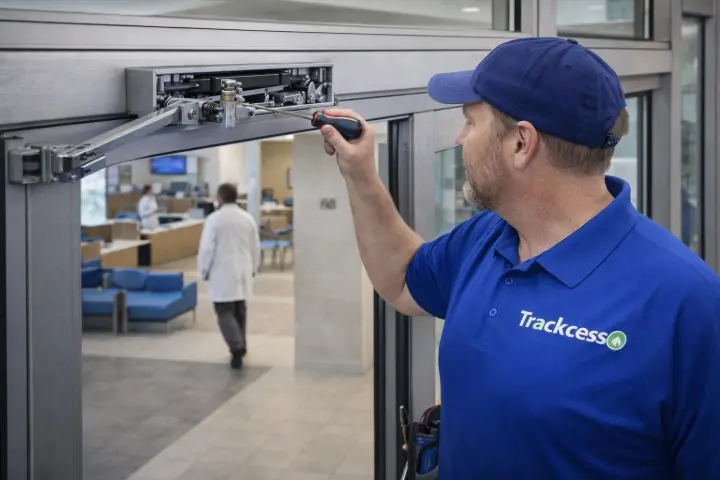
A lot of times building owners think it's one trade they need to bring in to install the door operator. They don't realize electricians have to run power to the door first. Then you can have a door operator installer install the door after the fact.
Technology has improved reliability.
The integration of the door controller being put into the unit itself is a significant development. In the past, you'd install the door operator and then install a secondary unit to manage the opening. If you push the button and it doesn't tell the electronic strike to release first before opening the door, it pushes up against the electrical strike.
That timing is called the sequencer. Now they're building them directly into the door operators.
You have less parts, meaning less things can go wrong.
Specify sensor type—motion, push-button, or touchless. Plan integration with building automation and maintenance SOPs. Avoid vague "smart door" claims without performance data.
Run and Measure Outcomes
Pull a report once you've installed the unit. Check to see if your electric bill or heating bills went down. Check the maintenance costs to see if the maintenance cost of the door itself went down.
Dashboard these metrics:
- Energy savings month over month
- Accessibility incidents tracked to zero
- System uptime percentage
- Tenant retention rates
Tie results to building value and sustainability certifications.
The Stone-Age Stack Creates Hidden Costs
Manual doors create maintenance calls for broken closers, liability from accessibility complaints, and lost revenue from tenants who prioritize modern, inclusive buildings.
A single audit that finds improper clearances, incorrect latch heights, or non-compliant thresholds can halt occupancy permits until you resolve issues. Planning errors create costly delays.
Modernize your entry systems now. Track compliance, energy performance, and tenant satisfaction. Measure ROI after one year.
Automatic doors are a business system. Install them as compliance infrastructure, never as a luxury feature.